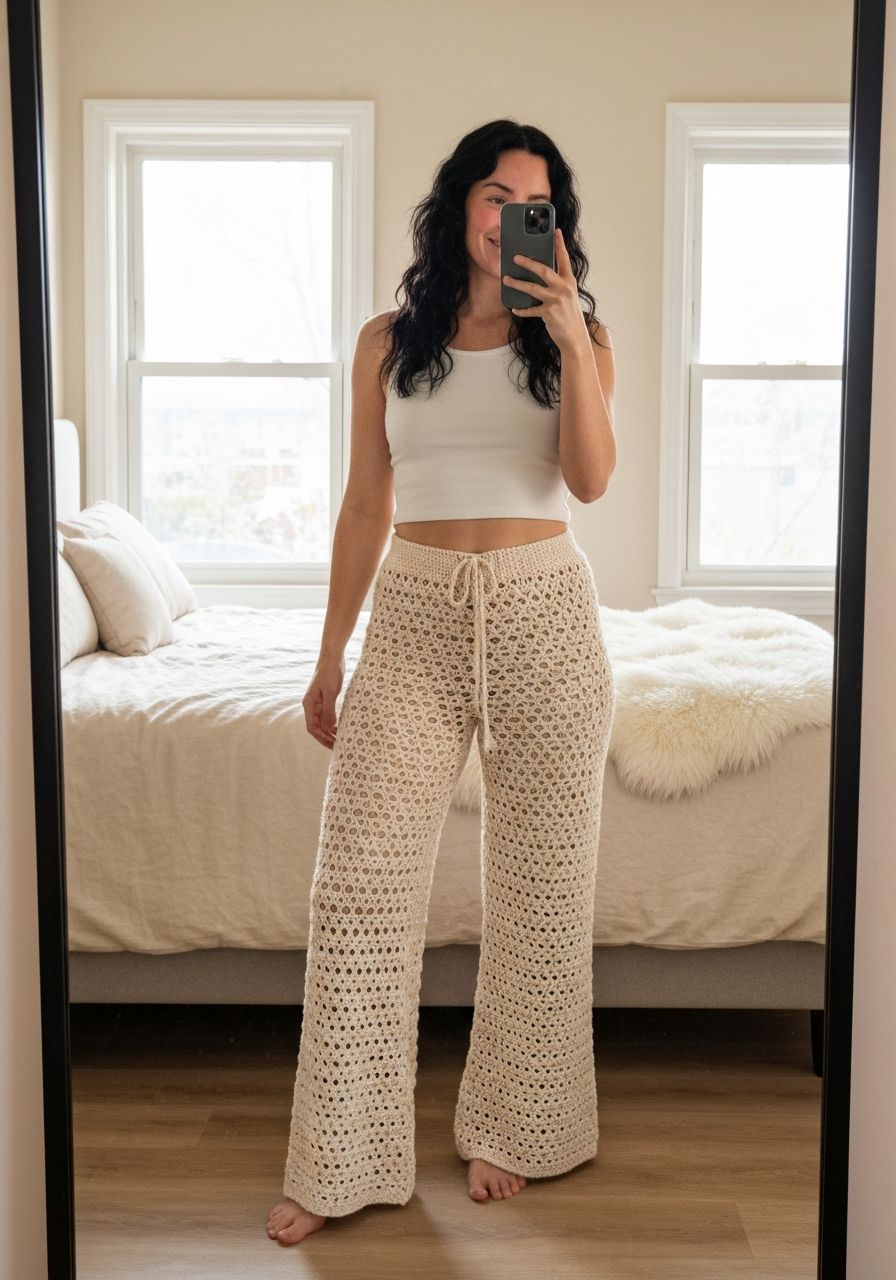
Imagine sinking into the softest, most comfortable pants you've ever worn – pants that flow with every step, making you feel effortlessly chic whether you're lounging at home or stepping out for a casual day. Picture a garment that combines the relaxed vibes of your favorite loungewear with the undeniable style of a high-fashion piece, all crafted by your own hands. Get ready to transform your wardrobe with the ultimate in cozy elegance, because today we’re diving into the wonderful world of creating your very own Crochet Wide Pants!
Welcome, fellow yarn enthusiasts, to a pattern that promises not just a beautiful finished garment, but a truly enjoyable making process. These wide-leg pants are designed for maximum comfort and style, featuring a flattering drape and a custom fit. Whether you're a seasoned crocheter looking for a rewarding project or an adventurous beginner eager to expand your skills, this guide will walk you through every stitch. Say goodbye to uncomfortable waistbands and restrictive designs, and hello to your new favorite handmade trousers.
Why You'll Love This Pattern
- Ultimate Comfort: Designed with a relaxed fit and excellent drape, these pants feel like a dream against your skin.
- Effortless Style: Wide-leg pants are a timeless fashion statement, offering a chic and sophisticated look that's easy to dress up or down.
- Customizable Fit: The pattern is written with clear instructions for adjusting length and waist circumference, ensuring a perfect fit for your unique body.
- Versatile Wear: Perfect for lounging, running errands, beach days, or even a stylish casual outing, depending on your yarn choice and styling.
- Skill-Building Project: While relatively simple, this pattern introduces you to working in the round, shaping, and creating a wearable garment from start to finish.
Materials Needed
- Yarn: DK (Light Worsted) Weight Yarn, Category 3. Approximately 1200-1600 yards (1100-1460 meters) depending on size and desired length. We recommend a cotton blend or bamboo blend for excellent drape and breathability.
- Crochet Hook: 4.0 mm (G-6) or size needed to obtain gauge.
- Elastic: 1-inch (2.5 cm) wide non-roll elastic, length equal to your waist measurement.
- Stitch Markers: At least 4.
- Tapestry Needle: For weaving in ends.
- Scissors.
- Measuring Tape.
Gauge & Sizing
Achieving the correct gauge is absolutely critical for pants to fit properly. Please do not skip this step!
Gauge Swatch: Chain 20. Work 15 rows of half double crochet (hdc). Your swatch should measure 4 inches (10 cm) wide by 4 inches (10 cm) tall. If your swatch is larger, try a smaller hook. If it's smaller, try a larger hook.
Sizing Information (Approximate Finished Hip Circumference):
- Small (S): 36-38 inches (91-96 cm)
- Medium (M): 40-42 inches (101-106 cm) - Pattern written for M, with notes for adjustments.
- Large (L): 44-46 inches (111-116 cm)
- Extra Large (XL): 48-50 inches (121-127 cm)
To Customize Sizing: Measure your hips at their widest point. The total number of stitches for the yoke (hip area) will need to be a multiple of the pattern repeat (if any) and roughly match your hip measurement plus 2-4 inches for ease. The pattern below is for a Medium. To adjust, you will need to modify the initial chain for the waistband and the number of increase rounds in the yoke section.
Abbreviations
- ch: Chain
- sl st: Slip Stitch
- sc: Single Crochet
- hdc: Half Double Crochet
- dc: Double Crochet
- inc: Increase (work 2 stitches into the same stitch)
- scBLO: Single Crochet Back Loop Only
- st(s): Stitch(es)
- sk: Skip
- rnd(s): Round(s)
- rep: Repeat
- pm: Place Marker
Step-by-Step Pattern
This pattern is worked from the top-down, starting with the waistband, then the yoke (hip area), and finally separating for the legs.
Waistband (Ribbed)
- Ch 11.
- Row 1: Sc in 2nd ch from hook and in each ch across. (10 sc)
- Row 2: Ch 1 (does not count as st), turn. ScBLO in each st across. (10 sc)
- Repeat Row 2 until your ribbed band measures your exact waist circumference when slightly stretched. For a size M, this is typically around 28-30 inches (71-76 cm) before joining. Make sure the number of rows is an even number for easier joining later.
- Join Waistband: Fold the band in half, bringing the first and last rows together. Slip stitch through the back loop of the last row and the corresponding chain of the first row to create a seamless join. Do not fasten off.
Yoke (Top of Pants)
Now we will work along the long edge of your ribbed waistband to create the main body of the pants, increasing to reach your hip measurement.
- Rnd 1: Ch 1 (does not count as st). Work 1 hdc into the end of each scBLO row around the top edge of the waistband. Join with sl st to first hdc. (Total hdc will be equal to the number of rows you made in the waistband. For size M, let's assume 76 hdc).
- Rnd 2: Ch 1, hdc in each st around. Join with sl st. (76 hdc)
- Rnd 3 (Increase Rnd): Ch 1, *hdc in next 9 sts, inc (2 hdc in next st)*. Repeat from * to * around. Hdc in remaining sts if necessary. Join with sl st. (Adjust your increase count to evenly space increases. For M, we'll aim for 84 hdc here, so 8 increases: hdc in 8, inc. 76/8 = 9.5, so hdc in 9, inc for 4 times, then hdc in 8, inc for 4 times.) Let's simplify: Ch 1, *hdc in next 8 sts, inc*. Repeat from * to * 8 times. Join with sl st. (84 hdc)
- Rnd 4-6: Ch 1, hdc in each st around. Join with sl st. (84 hdc)
- Rnd 7 (Increase Rnd): Ch 1, *hdc in next 10 sts, inc*. Repeat from * to * 7 times. Join with sl st. (91 hdc)
- Rnd 8-10: Ch 1, hdc in each st around. Join with sl st. (91 hdc)
- Rnd 11 (Increase Rnd): Ch 1, *hdc in next 12 sts, inc*. Repeat from * to * 7 times. Join with sl st. (98 hdc)
- Continue working even rounds of hdc and increase rounds (e.g., every 3-4 rounds, evenly spacing 7-8 increases) until your piece measures your widest hip circumference. For size M, your final stitch count here should be approximately 120-128 hdc. Let's aim for 120 hdc.
- For Size M (Continuing from Rnd 11):
Rnd 12-14: Ch 1, hdc in each st around. Join with sl st. (98 hdc)
Rnd 15 (Increase Rnd): Ch 1, *hdc in next 13 sts, inc*. Repeat from * to * 7 times. Join with sl st. (105 hdc)
Rnd 16-18: Ch 1, hdc in each st around. Join with sl st. (105 hdc)
Rnd 19 (Increase Rnd): Ch 1, *hdc in next 14 sts, inc*. Repeat from * to * 7 times. Join with sl st. (112 hdc)
Rnd 20-22: Ch 1, hdc in each st around. Join with sl st. (112 hdc)
Rnd 23 (Increase Rnd): Ch 1, *hdc in next 15 sts, inc*. Repeat from * to * 7 times. Join with sl st. (119 hdc)
Rnd 24-26: Ch 1, hdc in each st around. Join with sl st. (119 hdc - this is close enough to 120)
Separating for Legs
Lay your work flat, aligning the seam at the back-center. Place stitch markers to divide the stitches evenly for the front and back, and for the crotch area. For 119 stitches, we'll round to 120 for easier division.
- Count out half your total stitches. Mark the center of the front and back. (119 is odd, so let's say 60 for front, 59 for back, or just adjust slightly for easier division, like aiming for 120 in the last increase round. Let's assume 120 now for simplicity.)
- For 120 sts: Count 60 sts for the front, 60 sts for the back. The side seams (where the legs will separate) will be at the 30th and 90th stitch from the back seam.
- Mark the side points: From the back seam (where you joined your rounds), count forward 30 stitches and pm. Count forward another 60 stitches and pm. This marks the two points where the legs will separate.
- First Leg Prep: Ch 4 for the crotch space. Sk the stitches between the two markers on one side (e.g., 60 sts for the back, so skip the next 30 sts after the first marker, and then connect to the second marker). This forms the first leg opening.
Legs (Make Two)
You will now work each leg separately in the round.
- Leg 1 (Starting from a side marker): Ch 2 (counts as first dc). Work 1 dc in each hdc around the first half of the body (e.g., 60 sts). When you reach the chained stitches, work 1 dc into each of the 4 ch sts. Join with sl st to top of starting ch 2. (60 + 4 = 64 dc)
- Rnd 2-X: Ch 2, dc in each st around. Join with sl st to top of starting ch 2. (64 dc)
- Continue working even rounds of dc until the leg reaches your desired length from the crotch, or just above your ankle. For a typical full-length wide pant, this might be 40-50 rounds (or more/less depending on your height).
- Last Rnd: Ch 1, sc in each st around. Join with sl st. Fasten off.
- Leg 2: Join yarn at the other side marker. Repeat steps 1-5 for the second leg, ensuring the number of stitches and rounds match Leg 1.
Finishing
- Weave in all loose ends securely with your tapestry needle.
- Insert Elastic: Thread the 1-inch elastic through the top ribbed waistband. Overlap the ends of the elastic by about 1 inch and sew them together securely by hand or machine. Allow the elastic to gather the waistband.
- Optional: Lightly block your pants to enhance drape and even out stitches.
Pro Tips
- Yarn Choice Matters: For the best drape, select a yarn with good stitch definition and a smooth texture. Cotton, bamboo, or a lightweight acrylic blend are excellent choices. Avoid stiff yarns.
- Measure as You Go: Periodically try on your pants (or hold them up to existing pants that fit well) to check the length and hip circumference. This is especially important for the yoke section.
- Adjusting Length: To make the pants shorter or longer, simply work fewer or more rounds in the leg section.
- Crotch Depth: The number of chains for the crotch area can be adjusted. More chains will give a deeper, looser crotch; fewer chains will make it shallower. Ensure symmetry.
- Blocking is Your Friend: Especially with natural fibers, a good block can dramatically improve the drape and evenness of your stitches, giving your handmade pants a professional finish.
Frequently Asked Questions
Can I use a different yarn weight for these pants?
Yes, you can! However, be aware that changing yarn weight will significantly alter the final size and drape of your pants. You will need to adjust your hook size to match the new yarn and, most importantly, re-check your gauge. You'll likely need to adjust the initial stitch count for the waistband and the number of increase rounds in the yoke to achieve your desired hip circumference.
How do I adjust the length of the pants?
Adjusting the length is one of the easiest modifications! Once you've separated for the legs, simply continue crocheting in rounds until each leg reaches your desired length. You can try them on periodically (or measure against another pair of pants) to ensure you get the perfect inseam.
Is this pattern suitable for beginners?
While the pattern uses basic stitches (hdc, dc, sc), creating a fitted garment like pants can be a bit more challenging than a simple scarf or blanket. However, with patience, careful attention to gauge, and the ability to measure accurately, an adventurous beginner can absolutely tackle this project. Don't be afraid to try!
There you have it – your comprehensive guide to crocheting the most comfortable and stylish wide pants you'll ever own. We hope this pattern inspires you to pick up your hook and create something truly special for your wardrobe. Enjoy the process, savor the stitches, and get ready to strut your stuff in your fabulous new handmade creation!