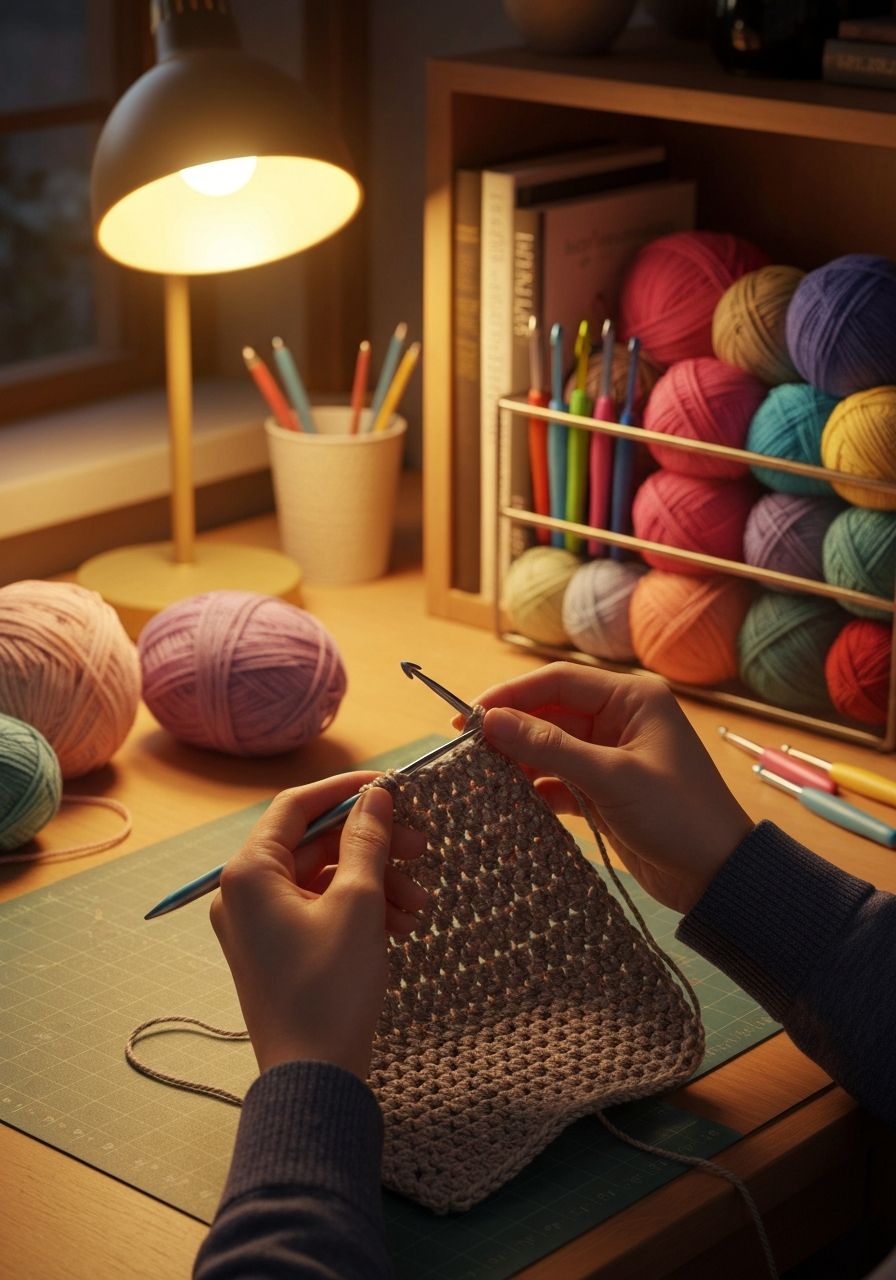
Imagine holding a simple strand of yarn, and with a flick of your wrist and a clever hook, transforming it into something wonderfully tactile and beautiful – a cozy blanket, a stylish scarf, or even a charming toy. That magic is within your reach, and the half double crochet (HDC) stitch is often the secret weapon that makes it happen with satisfying speed and incredible texture. It’s the perfect stitch to bridge the gap between simple and intricate, offering a unique fabric that’s not too dense, not too lacy, but just right for so many delightful projects. Get ready to fall in love with its rhythm and the beautiful fabric you're about to create!
The half double crochet stitch is often overlooked in favor of its simpler cousin, the single crochet (sc), or its taller relative, the double crochet (dc). However, the HDC holds a special place in the crocheter's toolkit, offering a fantastic balance of height, drape, and texture. It's truly a fundamental building block that will open up a vast world of patterns and possibilities, making it an essential skill for any aspiring crocheter.
Why It Matters: The Power of Half Double Crochet
The half double crochet isn't just another stitch; it's a versatile powerhouse that deserves a prime spot in your crochet repertoire. Here's why mastering it is so beneficial:
- Unmatched Versatility: From creating dense, warm fabrics for blankets and garments to adding subtle texture in amigurumi and accessories, HDC can do it all. Its medium height makes it suitable for a wide array of projects where you want more drape than single crochet but less openness than double crochet.
- Speed and Efficiency: Taller than a single crochet, HDC works up faster, allowing you to complete projects more quickly. This speed, combined with its lovely texture, makes it a favorite for larger items like scarves, shawls, and sweaters.
- Unique Texture: The way the HDC stitch is formed creates a distinctive horizontal bar on the back of the fabric, often referred to as the "third loop." Working into this loop can create beautiful ribbed textures, making it a favorite for cuffs, borders, and even entire fabric panels.
- Solid Foundation: Once you've mastered HDC, you'll find that many other intermediate and advanced stitches build upon its basic structure. It’s an excellent stepping stone to more complex patterns and techniques, boosting your confidence as you grow your skills.
What You Need to Know Before You Begin
Before diving into the mechanics of the half double crochet, let's make sure you have a few basics down and understand some common crochet terminology.
- Basic Stitches: You should be comfortable with making a slip knot, creating a foundation chain (ch), and ideally, know how to make a slip stitch (sl st) and a single crochet (sc). If not, a quick refresher on these will be incredibly helpful!
- Yarn and Hook: For beginners, a light-colored, smooth worsted weight (medium #4) acrylic or cotton yarn is ideal. It's easy to see your stitches and forgiving to work with. Pair it with a corresponding hook size, usually an H/5.0mm or I/5.5mm. Check your yarn label for recommended hook sizes.
- Terminology:
- Yarn Over (YO): Wrapping the yarn from back to front over your hook.
- Stitch (st): A single unit of crochet fabric.
- Row: A horizontal line of stitches.
- Turn: Rotate your work so the back is facing you, ready to start the next row.
- Work into the designated stitch: This means inserting your hook into the top 'V' of the stitch from the previous row, unless the pattern specifies otherwise (e.g., back loop only).
Mastering the Half Double Crochet (HDC) Stitch
Let's break down the half double crochet stitch step by step. This stitch creates a fabric that is roughly 1.5 times the height of a single crochet.
Anatomy of a Stitch
Before you learn the HDC, it's good to understand what a completed stitch looks like. When you look at the top edge of your crocheted fabric, each stitch will have a "V" shape. The loop closest to you is the front loop (FL), and the loop furthest from you is the back loop (BL). When a pattern says "insert hook into the stitch," it typically means inserting your hook under both of these loops (under the entire "V").
Step-by-Step Instructions for Half Double Crochet
Here’s how to make a half double crochet:
- Start with a foundation chain: Make a slip knot and chain several stitches. For practice, chain about 16 stitches.
- Yarn over (YO): Wrap the yarn from back to front over your hook. You will now have two loops on your hook (your original loop and the one from the YO).
- Insert hook: Insert your hook into the 3rd chain from your hook. (The first two chains count as your turning chain for HDC and effectively give your first stitch height). Make sure your hook goes under the top two strands of the chain for a sturdy edge.
- Yarn over (YO) and pull up a loop: Wrap the yarn over your hook again, and pull that wrapped yarn through the chain stitch you just inserted your hook into. You will now have three loops on your hook.
- Yarn over (YO) and pull through all three loops: Wrap the yarn over your hook one last time, and carefully pull that wrapped yarn through all three loops on your hook. This completes your first half double crochet stitch!
- Repeat: To continue, yarn over, insert your hook into the next chain stitch, YO and pull up a loop (3 loops on hook), then YO and pull through all 3 loops. Continue this process in each chain across your foundation.
Turning Chain for HDC
When you finish a row of half double crochet and need to start a new one, you'll create a "turning chain" to bring your yarn to the correct height for the next row. For HDC, the standard turning chain is 2 chains (ch 2).
- Does it count as a stitch? This is a common question! For HDC, the ch 2 at the beginning of a row usually does NOT count as a stitch. This means your first HDC of the new row will be worked into the very first stitch of the previous row (the one directly below your turning chain). Always check your pattern, as some designers may specify otherwise. For beginners, assuming it doesn't count simplifies stitch counting.
Practice Swatch Project: Your First HDC Fabric
Let's put those steps into practice with a simple swatch:
Getting Started
Make a slip knot and chain 16 stitches.
Row 1
HDC in the 3rd chain from your hook. This means you'll skip the first 2 chains and insert your hook into the 3rd. Work 1 HDC into each chain across the row. You should have 15 HDC stitches.
Row 2
Chain 2 (this does NOT count as a stitch, unless specified), then turn your work. Work 1 HDC into the very first stitch (the one directly below your turning chain). Continue working 1 HDC into each stitch across the row. Remember to work into the last stitch of the previous row (which can sometimes hide a bit). You should still have 15 HDC stitches.
Rows 3-10 (or more!)
Repeat Row 2 until your swatch is a square, or as tall as you like. The more you practice, the more consistent your tension and stitches will become.
Finishing
Once you're happy with your swatch, cut your yarn, leaving a 6-inch tail. Yarn over and pull the tail completely through the loop on your hook to fasten off. Weave in your ends with a yarn needle.
Common Mistakes to Avoid
Even seasoned crocheters make mistakes, especially when learning a new stitch. Here are some common pitfalls with HDC and how to avoid them:
- Skipping Stitches: A very common issue, particularly at the beginning and end of rows. Always count your stitches at the end of each row to ensure your piece isn't getting narrower or wider unintentionally.
- Incorrect Turning Chain: Using too few or too many chains for your turning chain can make your edges uneven. For HDC, stick to ch 2.
- Inconsistent Tension: If your stitches are sometimes tight and sometimes loose, your fabric will look uneven. Practice helps immensely, but also try to relax your grip on the yarn and hook.
- Not Inserting Hook Correctly: For a standard HDC, make sure your hook goes under both top loops of the stitch from the previous row. If you only go under one loop, your fabric will look different and potentially be less stable.
- Ignoring the "Third Loop": While sometimes used for decorative effect, if you consistently miss the typical top "V" and only work into the "third loop" (the horizontal bar at the back of the stitch), your fabric will have a distinct ribbed texture and may curl.
Pro Tips for Perfect HDC
Ready to elevate your half double crochet skills? These tips will help you achieve beautiful, consistent results every time:
- Use Stitch Markers: Place a stitch marker in the first and last stitch of your row. This makes it incredibly easy to identify where to place your first and last stitch of the next row, preventing accidental increases or decreases.
- Practice Tension: Different yarns behave differently. Experiment with holding your yarn in various ways until you find a method that gives you even, consistent tension. The goal is stitches that are neither too tight nor too loose.
- Explore the Third Loop: Once you're comfortable with standard HDC, try working solely into the "third loop" (the horizontal bar on the back of the stitch). This creates a stunning knitted-look ribbing that's fantastic for hat brims, cuffs, and scarves.
- Always Count Your Stitches: This cannot be stressed enough! Counting prevents errors early on and saves you from having to unravel (frog) your work later.
- Read Patterns Carefully: Pay close attention to how a pattern instructs you to handle the turning chain. Some patterns might count it as a stitch, which changes where you place your first HDC of the row.
Frequently Asked Questions
What's the difference between HDC and DC?
The main difference lies in their height and how they are formed. HDC (half double crochet) is shorter than DC (double crochet). To make an HDC, you yarn over once, insert your hook, yarn over and pull up a loop (3 loops on hook), then yarn over and pull through all 3 loops. For a DC, you yarn over once, insert your hook, yarn over and pull up a loop (3 loops on hook), then yarn over and pull through only 2 loops, and finally yarn over and pull through the remaining 2 loops. This extra pull-through makes the DC taller and creates a slightly looser fabric.
Does the turning chain for HDC count as a stitch?
Generally, for half double crochet, the starting chain of 2 does NOT count as a stitch. This means you will work your first HDC into the very first stitch of the previous row. However, pattern designers vary, so always check the specific instructions in your pattern. If it doesn't specify, assuming it doesn't count is a safe bet for consistent stitch counts.
Can I increase or decrease with HDC?
Absolutely! Increasing with HDC is done by simply working two (or more) half double crochet stitches into the same stitch. Decreasing with HDC is typically done using the "HDC2tog" (half double crochet two together) method: Yarn over, insert hook into next stitch, yarn over and pull up a loop (3 loops on hook), then insert hook into the *next* stitch, yarn over and pull up a loop (4 loops on hook), yarn over and pull through all 4 loops on your hook. This reduces two stitches into one.
Congratulations, you've just taken a monumental step in your crochet journey! The half double crochet stitch is more than just a technique; it's a gateway to creating beautiful, textured fabrics that will bring joy to you and those around you. With practice and patience, you'll master this versatile stitch and unlock a world of creative possibilities. Don't be afraid to experiment, try out different yarns, and most importantly, enjoy every moment of your crafting adventure. Happy crocheting!