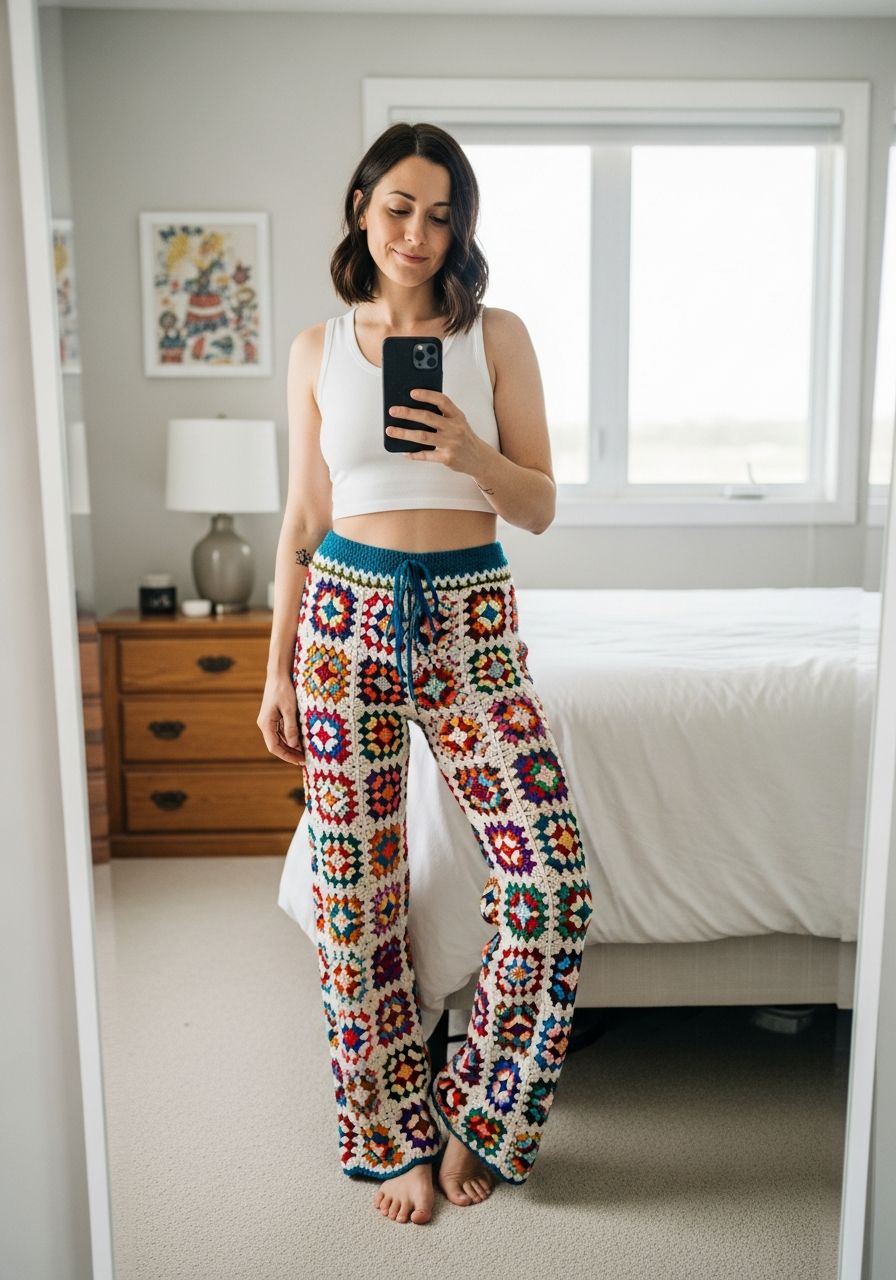
Imagine slipping into the ultimate combination of comfort and playful style – pants that tell a story with every stitch, bursting with vibrant color and a delightfully retro vibe. If you've been dreaming of making a statement with your handmade wardrobe, then get ready to fall head over heels for our free pattern for effortlessly chic crochet granny square pants! This isn't just a garment; it's a wearable piece of art that promises endless compliments and cozy satisfaction. Let's grab our hooks and yarn, because your next favorite outfit is just a few granny clusters away!
Welcome, fellow yarn enthusiasts, to a truly unique crochet adventure! This comprehensive guide will walk you through creating your very own pair of stunning granny stitch pants, designed to flatter and inspire. Whether you're a seasoned crocheter looking for a fun new challenge or an adventurous beginner eager to expand your skills, this pattern is crafted with you in mind. We'll cover everything from selecting your materials to mastering the iconic granny stitch, assembling your panels, and adding those perfect finishing touches. Prepare to infuse your wardrobe with handmade charm and unparalleled comfort!
Why You'll Love This Pattern
- Unique Style Statement: Stand out from the crowd with a truly one-of-a-kind garment that exudes bohemian charm and retro coolness.
- Ultimate Comfort: Crocheted fabric offers a lovely drape and breathability, making these pants incredibly comfortable for lounging or styling out.
- Customizable Colors: This pattern is a fantastic opportunity to play with color combinations, from a cohesive single-color look to a riot of stash-busting hues.
- Skill-Building Project: While the granny stitch is simple, constructing a garment like pants will challenge you to think about shaping, joining, and fit, growing your crochet expertise.
- Wearable Art: Every stitch is a testament to your creativity and dedication, resulting in a functional piece of art you can wear proudly.
- Sustainable Fashion: Create a lasting garment that reduces waste and champions slow fashion.
Materials Needed
- Yarn: Worsted Weight (Category 4) cotton or acrylic yarn. Approximately 1600-2000 yards for a women's M/L. (e.g., Scheepjes Colour Crafter, Lion Brand Vanna's Choice)
- Crochet Hook: 5.0 mm (H-8) or size needed to obtain gauge.
- Scissors: For cutting yarn ends.
- Tapestry Needle: For weaving in ends and seaming.
- Stitch Markers: Essential for marking rounds, increases, and special points.
- 1-inch wide Elastic: Enough to fit comfortably around your waist (approximately 28-36 inches for M/L).
Gauge & Sizing
Getting your gauge right is crucial for ensuring your pants fit as intended. The granny stitch naturally has a bit of give, but consistency is key. We'll be working with granny clusters.
Gauge Swatch: Create a granny stitch swatch that is at least 6 inches by 6 inches. A common way to measure granny stitch gauge is by counting clusters and rows within a given area.
- 4 granny clusters (3 dc, ch 1) x 5 rows = 4 inches (10 cm).
Sizing Notes: This pattern is written for a Women's size M/L (approx. 30-32 inch waist, 40-42 inch hip). To adjust the size, you will need to modify your initial chain length for the leg openings and the number of increase rounds to achieve your desired hip and thigh circumference. Always measure against your body or a pair of well-fitting pants as you go. For a smaller size, decrease your initial chain in multiples of 3. For a larger size, increase your initial chain in multiples of 3 and add more increase rounds.
Abbreviations
- ch: Chain
- sl st: Slip stitch
- sc: Single crochet
- hdc: Half double crochet
- dc: Double crochet
- ch-sp: Chain space
- sk: Skip
- rep: Repeat
- st(s): Stitch(es)
- Rnd(s): Round(s)
- FO: Fasten off
Step-by-Step Pattern
This pattern constructs the pants using a continuous granny stitch in the round, starting from the ankle and working upwards. This allows for a seamless finish and easy adjustments.
The Granny Stitch Leg (Make 2)
We will begin by creating the first pant leg. You will then repeat this entire section for the second leg.
- Initial Chain: Ch 72. Join with a sl st to the first ch to form a ring, being careful not to twist the chain. (This forms the ankle opening for approx. 12-inch circumference for a M/L. Adjust in multiples of 3 for different sizes).
- Rnd 1: Ch 3 (counts as 1 dc here and throughout), 2 dc in the same st as join. Sk 2 ch, *3 dc in next ch, sk 2 ch*. Repeat from * around until 3 ch remain. Sl st to the top of the beginning ch 3 to join. (24 granny clusters)
- Rnd 2: Sl st into the first 2 dc and into the first ch-2 space. Ch 3, 2 dc in the same ch-2 sp. *Ch 1, 3 dc in next ch-2 sp*. Repeat from * around. Ch 1, sl st to the top of the beginning ch 3 to join. (24 granny clusters, 24 ch-1 spaces)
- Rnds 3-8: Repeat Rnd 2. At the end of Rnd 8, your leg should have grown slightly.
- Increase Rnd (Rnd 9): Sl st into the first 2 dc and into the first ch-1 space. Ch 3, 2 dc in the same ch-1 sp. *Ch 1, 3 dc in next ch-1 sp*. Repeat from * for 11 clusters. In the next ch-1 space, work (3 dc, ch 1, 3 dc) to create an increase. Continue with *Ch 1, 3 dc in next ch-1 sp* for the remaining clusters. Ch 1, sl st to the top of the beginning ch 3 to join. (25 granny clusters, 25 ch-1 spaces).
- Rnds 10-14: Repeat Rnd 2, working into the new ch-1 spaces created by the increase. (25 granny clusters)
- Increase Rnd (Rnd 15): Repeat the increase from Rnd 9, adding another (3 dc, ch 1, 3 dc) in one of the ch-1 spaces. Try to space your increases somewhat evenly around the leg. (26 granny clusters).
- Rnds 16-30 (or desired length): Continue working Rnd 2, adding an increase round approximately every 5-6 rounds, or as needed to achieve your desired thigh circumference. You should increase by one cluster each time. Aim for a total of 28-30 clusters per round by the time you reach your upper thigh/crotch area. Work until the leg measures your desired inseam length (from ankle to crotch). Do not FO after the second leg.
Joining the Legs & Creating the Rise
Now we'll connect the two completed legs and work upwards to form the body of the pants.
- Join Legs: With the hook still in the last st of the second leg, Ch 2. Pick up the first leg and sl st into any ch-1 space on the first leg. Ch 2. This connects the two legs. Make sure the legs are not twisted.
- Rnd 1 (Body): Sl st into the first ch-1 sp of the first leg. Ch 3, 2 dc in the same sp. Continue working *Ch 1, 3 dc in next ch-1 sp* around the first leg. When you reach the ch-2 space where the legs are joined, work 3 dc into the first ch of the ch-2 space, Ch 1, 3 dc into the second ch of the ch-2 space. Continue working *Ch 1, 3 dc in next ch-1 sp* around the second leg. When you reach the next ch-2 space where the legs are joined, work 3 dc into the first ch of the ch-2 space, Ch 1, 3 dc into the second ch of the ch-2 space. Sl st to the top of the beginning ch 3 to join. (You should now have a continuous circle of granny clusters).
- Rnd 2 (Body): Sl st into the first 2 dc and into the first ch-1 space. Ch 3, 2 dc in the same ch-1 sp. *Ch 1, 3 dc in next ch-1 sp*. Repeat from * around the entire body. Ch 1, sl st to the top of the beginning ch 3 to join.
- Rnds 3-12 (Rise): Repeat Rnd 2 until the rise measures your desired length (from crotch to waist). You can try on the pants to check the fit. If you need to make the rise wider for larger sizes, you can occasionally add an increase (3 dc, ch 1, 3 dc) in a ch-1 space, but generally, the straight granny stitch will create a good drape for the rise.
The Waistband
A comfortable and secure waistband is essential for pants.
- Waistband Foundation: After completing the rise, sl st into the first 2 dc and into the first ch-1 space. Ch 1, sc in the same ch-1 sp. Sc in each dc and each ch-1 sp around the top edge of the pants. Sl st to the first sc to join. (This provides a solid base for the waistband).
- Ribbed Waistband (Optional Elastic Casing): For a sturdy waistband that can house elastic, we'll create a folded casing. Ch 3 (counts as first dc), dc in each sc around. Sl st to the top of the beginning ch 3. Repeat for 4-5 more rounds of dc. When you have your desired height for the casing, fold the last round of dc inwards and sl st or sc it to the sc foundation round, leaving a small opening. Thread your elastic through this casing, secure the elastic ends, and then close the opening.
- Simple Ribbing: If you prefer a simpler ribbed waistband without elastic, after the sc foundation, Ch 2 (counts as first hdc). Hdc in each sc around. Sl st to the top of the beginning ch 2. For the next rounds, Ch 2, *hdc in the back loop only (BLO) of each hdc around*. Repeat * around for 5-7 rounds for a comfortable ribbed band. FO.
Finishing the Cuffs
Add a clean finish to the bottom of your pant legs.
- Cuff Rnd 1: Attach yarn to any ch-1 space at the ankle opening. Ch 1, sc in the same ch-1 sp. Sc in each dc and each ch-1 sp around the ankle opening. Sl st to the first sc to join.
- Cuff Rnd 2 (Optional Ribbing): Ch 2 (counts as first hdc). Hdc in each sc around. Sl st to the top of the beginning ch 2. For the next rounds, Ch 2, *hdc in the BLO of each hdc around*. Repeat * around for 3-5 rounds for a snug cuff. FO.
- Weave in Ends: Using your tapestry needle, carefully weave in all loose yarn ends throughout the pants. This is crucial for a professional finish and preventing unraveling.
Pro Tips
- Yarn Choice Matters: Cotton yarn offers great drape and breathability, perfect for warmer weather. Acrylic is durable and budget-friendly. Consider a blend for the best of both worlds.
- Try As You Go: Crochet fabric can stretch and behave differently than expected. Try on your pants frequently as you work, especially when approaching the thigh and waist, to ensure a good fit.
- Color Play: Don't be afraid to experiment with color! Use a solid color for a modern look, or switch colors every few rounds or for each leg for a true granny square aesthetic.
- Seamless Joins: When changing colors or starting new rounds, learn an invisible join technique (like the 'standing double crochet' or 'false stitch') to make your seams less noticeable.
- Blocking: While not always necessary for granny stitch, blocking your finished pants can help even out stitches, improve drape, and make your garment look more polished.
- Care: Hand wash or machine wash on a gentle cycle with cold water. Lay flat to dry to maintain shape.
Frequently Asked Questions
Can I use a different yarn weight for this pattern?
Yes, you can! However, using a different yarn weight will significantly alter your gauge and therefore the overall size of the pants. If you use a lighter weight yarn (e.g., DK or sport), you'll need to increase your initial chain length and potentially add more clusters per round. For a heavier weight yarn (e.g., bulky), you'll need fewer chains and clusters. Always make a substantial gauge swatch with your chosen yarn and adjust your hook size accordingly to achieve a fabric you like. Remember to have enough yardage for the heavier yarns.
How do I adjust the sizing for a smaller or larger fit?
Adjusting the size primarily involves changing your initial chain length for the legs and the number of increase rounds. For a smaller size, start with an initial chain that is a multiple of 3 and fits snugly around your ankle/calf. Reduce the number of increase rounds or decrease the number of clusters added in each increase round to achieve the desired thigh and hip circumference. For a larger size, increase your initial chain (still a multiple of 3) and add more increase rounds, or add more clusters per increase round, to accommodate larger measurements. Measure your hips, thighs, and inseam, and compare them to your crocheted fabric as you go.
Is this pattern suitable for beginners?
While the granny stitch itself is quite beginner-friendly, constructing a pair of pants involves shaping, working in the round, joining elements, and understanding garment construction, which can be a step up from simpler projects. If you're a beginner, it's recommended to have a good grasp of basic stitches (ch, sl st, sc, dc) and how to read a pattern. Take your time, use stitch markers liberally, and don't be afraid to unravel and re-do sections. This pattern is a fantastic way to challenge yourself and expand your skills!
And there you have it – your complete guide to crocheting your very own pair of incredibly stylish and comfortable granny square pants! This project is more than just making a garment; it's about embracing your creativity, honing your skills, and creating something truly unique that reflects your personal flair. We can't wait to see your vibrant creations. Happy crocheting!