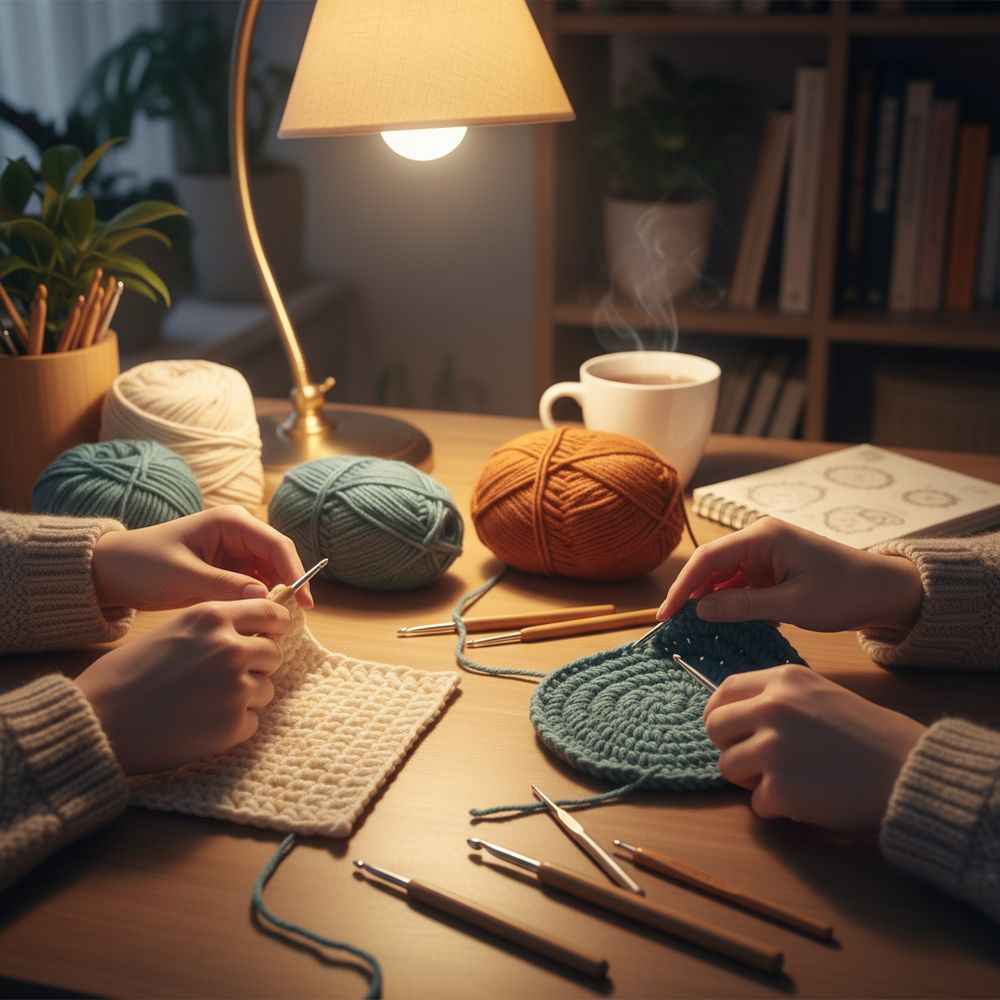
Imagine holding in your hands a beautiful, soft blanket that keeps you warm on a chilly evening, or a perfectly shaped, adorable amigurumi toy that brings a smile to a child's face. Both of these magical creations begin with the same simple stitches, yet they are built using two fundamentally different approaches: working your crochet
As a beginner, navigating the world of crochet can feel a bit like learning a new language. You've got your chain stitches, single crochets, double crochets, and the ever-present hook. But very quickly, you'll encounter patterns that tell you to 'turn your work' or 'join with a slip stitch' – these instructions are your first clues into whether you're working flat or in the round. Understanding these core methods is crucial for creating everything from washcloths and scarves to hats and intricate amigurumi. This guide will thoroughly break down each technique, providing clear examples and essential tips to help you confidently choose and execute the right method for your next masterpiece.
Why It Matters
The choice between crocheting flat and crocheting in the round isn't merely a stylistic one; it profoundly impacts the structure, drape, and ultimate appearance of your finished project. Think about it: a flat piece of crochet, like a dishcloth or a scarf, is designed to lay flat, often rectangular or square, with distinct edges that are created by turning your work. A piece worked in the round, conversely, is designed to create a continuous, seamless fabric, perfect for three-dimensional items like hats, toys, or even seamless garments.
Knowing which method to use, and why, is vital for several reasons:
- Project Suitability: Certain projects inherently demand one method over the other. Blankets are typically flat; hats are typically round.
- Pattern Comprehension: Patterns are written with specific instructions for flat or round work. Understanding the underlying principle makes reading and following them much easier.
- Fabric Characteristics: Flat crochet often has a more defined 'right' and 'wrong' side (though many stitches are reversible), while round crochet, especially in a spiral, produces a more consistent, seamless fabric throughout.
- Fit and Shaping: Creating shapes like sleeves, yokes, or complex amigurumi forms relies heavily on the ability to increase and decrease stitches effectively within either a flat or round construction.
- Efficiency: For some projects, working in the round can eliminate the need for seaming, saving you time and creating a cleaner finish.
What You Need to Know
Before we dive into the specifics of flat vs. round, let's refresh some basic crochet terms and techniques that will be essential:
- Ch (Chain): The foundation of most crochet projects.
- Sl St (Slip Stitch): Used for joining, moving across stitches without adding height, or finishing.
- Sc (Single Crochet): A short, dense stitch.
- Hdc (Half Double Crochet): A medium-height stitch.
- Dc (Double Crochet): A taller, looser stitch.
- Inc (Increase): Working two or more stitches into a single stitch to add stitch count.
- Dec (Decrease): Working two or more stitches together to reduce stitch count.
- Turning Chain: A chain made at the end of a row before turning, to bring the yarn to the correct height for the next row.
- Magic Ring (or Magic Circle): A method for starting crochet in the round that creates a tightly closed center, popular for amigurumi.
Crochet Flat vs. Round: A Deep Dive
Let's break down each method with practical examples.
Crocheting Flat: The Basics
When you crochet flat, you work back and forth in rows, creating a two-dimensional fabric. Think of it like knitting – you reach the end of a row, turn your work, and start crocheting back in the opposite direction.
Key Characteristics:
- Foundation Chain: Most flat projects begin with a foundation chain.
- Rows: You work in distinct rows, usually numbered.
- Turning Chains: At the end of each row, you create a turning chain (e.g., ch 1 for sc, ch 2 for hdc, ch 3 for dc) before turning your work to maintain even edges and the correct stitch height.
- Seaming: Larger flat pieces might be seamed together to form a 3D object (e.g., sewing two flat panels to make a bag).
Example: Simple Scarf (Flat)
- Foundation Chain: Ch 21 (or any desired length + 1 for turning).
- Row 1: Sc in the 2nd ch from the hook and in each ch across. (20 sc)
- Row 2: Ch 1 (this is your turning chain), turn your work. Sc in the first sc and in each sc across. (20 sc)
- Repeat Row 2: Continue repeating Row 2 until your scarf reaches the desired length.
- Finish: Fasten off and weave in ends.
Notice how you always turn your work and make a turning chain. This creates the characteristic straight edges of flat crochet.
Crocheting in the Round: The Basics
Crocheting in the round creates a continuous, often circular or cylindrical, piece of fabric. Instead of turning, you work around a central point or along the edge of a previous round.
Key Characteristics:
- Starting Methods: Most projects start with a Magic Ring (for a tight center) or by chaining and joining into a ring (for a slightly larger hole).
- Rounds: You work in continuous rounds, which can be joined or worked in a spiral.
- Increasing: To create a flat circle, you'll typically increase stitches evenly in each round. To create a cylinder, you generally work the same number of stitches in each round after establishing the initial circumference.
- No Turning: You usually don't turn your work when crocheting in the round (unless specifically instructed for texture).
- Joining Rounds vs. Spiral:
- Joined Rounds: At the end of each round, you join with a sl st to the first stitch of that round, then chain up to start the next round. This creates a visible seam but results in very even stitch alignment.
- Spiral Rounds: You simply continue working into the first stitch of the previous round without joining. This creates a seamless fabric, ideal for amigurumi, but requires a stitch marker to keep track of the start of each round.
Example: Simple Coaster (in the Round, Joined)
- Round 1 (Magic Ring): Make a Magic Ring. Ch 2 (counts as first hdc). Work 9 hdc into the ring. Join with a sl st to the top of the beginning ch 2. (10 hdc)
- Round 2: Ch 2 (counts as first hdc). Hdc inc in the same stitch (where you joined). Hdc inc in each remaining hdc around. Join with a sl st to the top of the beginning ch 2. (20 hdc)
- Round 3: Ch 2 (counts as first hdc). Hdc in the next stitch. *Hdc inc in the next stitch, hdc in the next stitch* around. Join with a sl st to the top of the beginning ch 2. (30 hdc)
- Finish: Fasten off and weave in ends.
Example: Simple Amigurumi Base (in the Round, Spiral)
- Round 1 (Magic Ring): Make a Magic Ring. Sc 6 into the ring. (6 sc)
- Round 2: Sc inc in each of the 6 sc around. (12 sc). *Place a stitch marker in the first stitch of this round, and move it up with each new round to mark the beginning.*
- Round 3: *Sc in the next sc, sc inc in the next sc* around. (18 sc)
- Round 4: *Sc in the next 2 sc, sc inc in the next sc* around. (24 sc)
- Continue: Keep increasing in this manner (e.g., R5: *sc 3, inc* around) until your circle reaches the desired size, then stop increasing to create a cylindrical wall.
Common Mistakes to Avoid
- Forgetting Turning Chains (Flat): This leads to uneven edges and a shrinking project. Always remember your ch 1, ch 2, or ch 3 before turning.
- Working into the Turning Chain (Flat): Unless specifically instructed, you usually skip the turning chain and work into the first actual stitch of the previous row. Working into the turning chain can add extra stitches.
- Not Joining Correctly (Joined Rounds): Missing the sl st to join or joining into the wrong stitch (like the chain space instead of the actual stitch) will create a wonky seam or an incorrect stitch count.
- Losing Track in Spiral Rounds: Without a stitch marker, it's incredibly easy to lose your place in a spiral, leading to incorrect stitch counts and distorted shapes.
- Incorrect Starting Method for Round Projects: Using a chain loop instead of a magic ring for amigurumi can leave an unsightly hole in the center. Conversely, a magic ring might be too tight for a very open lace project.
- Inconsistent Tension: This affects both flat and round projects, leading to uneven fabric, gaps, or puckering. Practice makes perfect!
Pro Tips
- Use Stitch Markers Liberally: For flat projects, place markers in the first and last stitch of a row to ensure you don't accidentally add or subtract stitches. For spiral rounds, a stitch marker is non-negotiable for marking the beginning of each round.
- Swatch, Swatch, Swatch: Before committing to a large project, make a small sample (a swatch) using the specified yarn, hook, and stitch pattern. This helps you check your gauge and practice the technique.
- Count Your Stitches: Seriously, count them! Especially in the beginning. It's much easier to catch a mistake early than to unravel several rows or rounds later.
- Read the Pattern Carefully: Pay close attention to whether the pattern instructs you to 'turn,' 'join,' 'work in a spiral,' or 'chain up' at the beginning of a row/round.
- Understand Your Yarn: Different yarn weights and fibers behave differently. A plush chenille will hide minor imperfections better than a crisp cotton.
- Practice Basic Shapes: Make a dozen flat squares and a dozen flat circles. This repetition will build muscle memory and solidify your understanding of increases, decreases, turning chains, and joining.
Frequently Asked Questions
Can I turn a flat project into a round one?
Not directly, in terms of the initial construction, but you can certainly take flat pieces and assemble them into a three-dimensional object. For example, you can crochet two flat squares and seam them together along three sides to create a pouch, or crochet a long flat strip and seam its ends together to form a tube, which you could then add rounds to for a sleeve or bag. Borders worked in the round can also be added to flat pieces.
What's the best way to join rounds?
For most patterns that call for joining, a slip stitch (sl st) into the first stitch of the previous round (or the top of the turning chain) is standard. For a truly invisible seam, you can research the 'invisible join' technique, which uses a yarn needle to create a seamless finish, especially useful for projects like granny squares or color changes in the round.
When should I use a magic ring?
The magic ring (or magic circle) is your go-to for any project where you want a tight, closed center. This includes amigurumi (crocheted toys), the start of hats, mandalas, or any circular project where a gap in the center would be undesirable. If you need a slightly larger hole at the center (e.g., for a buttonhole, or a very open lace design), starting with a chain and then slip stitching to form a loop might be more appropriate.
Congratulations, you've just taken a giant leap in your crochet journey! Understanding the fundamental difference between Crochet Flat Vs Round is like learning the two main architectural styles of the craft. It's the knowledge that empowers you to look at any pattern, any finished object, and comprehend how it was built. Don't be afraid to experiment, make mistakes, and most importantly, practice. Each stitch, whether in a straight line or a continuous spiral, is a step towards becoming a more confident and creative crocheter. Happy hooking!