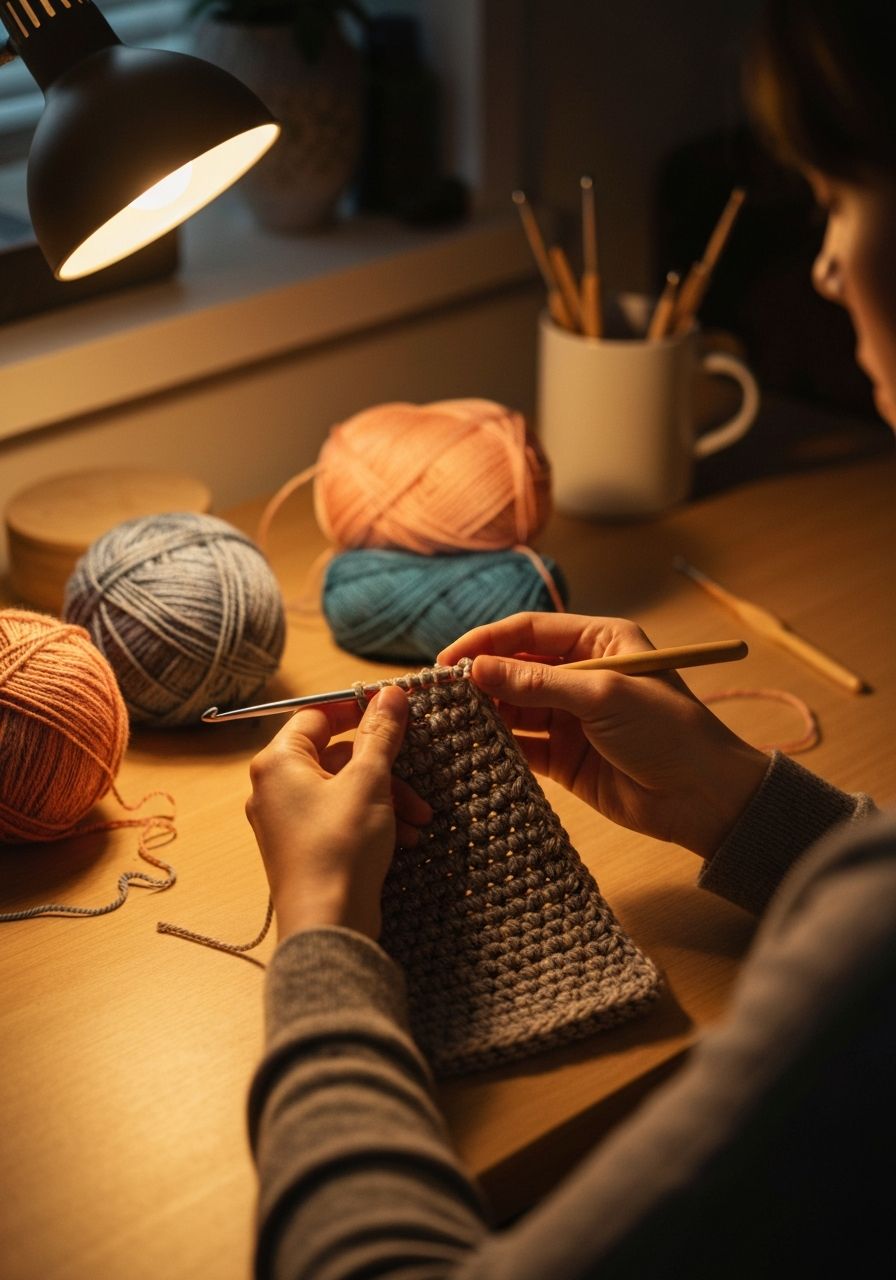
Imagine the cozy warmth of a blanket you crocheted yourself, the intricate texture of a scarf that's uniquely yours, or the whimsical charm of a amigurumi toy brought to life by your hands. All these wonderful creations, and countless more, often begin with one fundamental, incredibly versatile stitch: the Crochet Double Crochet. This guide isn't just about learning a stitch; it's about unlocking a world of creative possibilities, empowering you to transform simple yarn into cherished treasures. Get ready to fall in love with the rhythmic dance of hook and yarn, because mastering the double crochet is your gateway to a lifetime of beautiful handmade joy!
Welcome, budding crocheter! If you're eager to move beyond the foundational chain and single crochet, the double crochet (dc) stitch is your next essential step. It's one of the most frequently used stitches in crochet patterns worldwide, known for its height, speed, and beautiful drape. Unlike the compact single crochet, the double crochet creates a taller, airier fabric that works up quickly, making it ideal for everything from garments and blankets to accessories and home decor. By the end of this comprehensive guide, you'll not only understand how to execute a perfect double crochet but also gain the confidence to incorporate it into your own projects.
Why It Matters
The double crochet stitch is a cornerstone of the crochet world, and for good reason. Its height makes it faster to complete projects compared to single crochet, which means those dream blankets and sweaters come to life much more quickly. It also creates a fabric with excellent drape, meaning it flows and hangs beautifully, which is perfect for wearable items. Beyond its practicality, the double crochet offers a lovely texture, showcasing the yarn's qualities and forming a satisfying pattern on its own. Many other advanced stitches are built upon the mechanics of the double crochet, so understanding it thoroughly will open doors to a vast array of more complex techniques and patterns. Learning this stitch isn't just about adding another tool to your crafting belt; it's about gaining proficiency in a technique that will serve as the foundation for nearly every crochet journey you embark upon.
What You Need to Know
Before we dive into the actual stitch, let's ensure you have the basics covered and understand the terminology. If you haven't already, practice your slip knot and foundation chain (ch) until they feel comfortable. These are the starting points for almost every crochet project.
- Yarn: Start with a smooth, medium-weight yarn (like a worsted weight or Aran) in a light color. This makes it easier to see your stitches and identify where to insert your hook.
- Crochet Hook: Match your hook size to your yarn's recommendation. For worsted weight yarn, a 5.0mm (H-8) or 5.5mm (I-9) hook is a good starting point.
- Scissors: For cutting yarn ends.
- Tapestry Needle: For weaving in ends.
- Abbreviations: In patterns, double crochet is often abbreviated as 'dc' (US terminology).
- Turning Chain: When working in rows, you'll need a "turning chain" at the end of each row to bring your yarn up to the correct height for the next row. For double crochet, the turning chain is typically 3 chains (ch 3), and it usually counts as the first double crochet stitch of the new row.
- Yarn Over (yo): This means wrapping the yarn from back to front over your hook. It's a fundamental movement in double crochet.
Mastering the Double Crochet Stitch: Step-by-Step
Let's get your hook and yarn ready! We'll start by making a small practice swatch.
-
Getting Started: Your Foundation Chain
First, make a slip knot and chain (ch) 15 stitches. This will give you a good length to practice on. Remember, for double crochet, your turning chain (ch 3) usually counts as your first stitch, and you'll work into the 4th chain from your hook. So, for a row of 13 double crochets, you need to chain 15.
-
The First Double Crochet
- Yarn over (yo): Wrap the yarn from back to front over your hook. You should now have two loops on your hook.
- Insert hook: Skip the first 3 chains from your hook (these count as your first dc). Insert your hook into the 4th chain from your hook.
- Yarn over (yo) and pull up a loop: Wrap the yarn over your hook again and pull it through the chain stitch. You should now have three loops on your hook.
- Yarn over (yo) and pull through two loops: Wrap the yarn over your hook and pull it through the first two loops on your hook. You should now have two loops remaining on your hook.
- Yarn over (yo) and pull through the last two loops: Wrap the yarn over your hook one more time and pull it through the remaining two loops on your hook.
Congratulations! You've just made your first double crochet stitch. It should look like a small 'T' shape.
-
Working Across the Row
To continue your row, repeat steps 1-5 of "The First Double Crochet" in each remaining chain stitch across your foundation chain. You should end up with 13 double crochet stitches (remembering that your initial chain 3 counts as one dc).
-
Turning and Continuing
- Chain 3 (ch 3): At the end of your row, chain 3. This is your turning chain, and it will count as the first double crochet of your next row.
- Turn your work: Flip your fabric over so the back side is now facing you.
- Work into the first stitch: Skip the very first stitch of the previous row (the one directly below your turning chain 3) because your turning chain already accounts for it. Insert your hook into the *top of the second double crochet* of the previous row. (It's crucial not to work into the stitch at the base of your turning chain, or you'll accidentally increase your stitch count.)
- Continue across: Work one double crochet into each double crochet stitch across the row, including the top of the turning chain 3 from the *previous* row (which counted as a stitch).
Keep practicing these rows until you feel comfortable with the rhythm of the stitch and your tension is even. You'll soon have a beautiful swatch of double crochet fabric!
Common Mistakes to Avoid
Even seasoned crocheters can make these errors, so don't be discouraged! Awareness is the first step to perfection.
- Incorrect Turning Chain: Forgetting the turning chain, or using too few (e.g., ch 2 instead of ch 3), will make your edges uneven and your fabric curve. Using too many (e.g., ch 4) will create a gap at the edge.
- Skipping Stitches: Accidentally missing a stitch, especially at the ends of rows, will cause your project to narrow. Always count your stitches after each row until you're confident.
- Working into the Wrong Stitch: A common mistake for beginners is working into the turning chain of the previous row *as well as* the first stitch, or conversely, skipping the very last stitch (the turning chain of the previous row). This leads to increases or decreases.
- Inconsistent Tension: Some stitches might be too tight, others too loose, making your fabric uneven and bumpy. Practice is key to developing consistent tension.
- Twisted Fabric: Ensure you always turn your work in the same direction at the end of each row. If you turn inconsistently, your fabric can twist.
Pro Tips for Perfect Double Crochet
- Practice Swatches are Your Best Friend: Don't jump straight into a big project. Make several small swatches until your stitches are consistent and you understand the stitch mechanics.
- Count Your Stitches: This cannot be stressed enough, especially when learning. Count after *every* row. Stitch markers can help you mark the first and last stitch.
- Watch Your Tension: Try to keep the yarn flowing smoothly through your non-dominant hand. If your stitches are too tight, try a larger hook. If they're too loose, try a smaller hook or adjust how you hold your yarn.
- Identify the 'V': Each stitch has a 'V' shape on top. This is where you insert your hook for the next row. Learning to identify this quickly will speed up your crocheting.
- Mind Your Edges: Straight edges are a sign of a well-executed project. Always pay close attention to your turning chain and where you place your first and last stitches. For double crochet, the turning chain 3 usually counts as the first dc, so you skip the first stitch and work into the second. Then, make sure your last stitch is worked into the top of the turning chain 3 from the previous row.
- Experiment with Yarns: Once you're comfortable, try double crochet with different yarn weights and fibers. You'll be amazed at how different the same stitch can look!
Double Crochet FAQ
What's the difference between US and UK Double Crochet?
This is a crucial distinction! In US crochet terminology, 'double crochet' (dc) is the stitch we've just learned. However, in UK crochet terminology, the 'double crochet' (dc) is equivalent to the US 'single crochet' (sc). The US 'double crochet' is called a 'treble crochet' (tr) in UK patterns. Always check the pattern's origin or its stated terminology before you begin!
How do I make a Double Crochet increase or decrease?
- Increase (dc inc): To increase, simply work two double crochet stitches into the same stitch. This adds one stitch to your row.
- Decrease (dc dec or dc2tog - double crochet 2 together): To decrease, you'll work two stitches together. Yarn over, insert hook into the first stitch, yarn over, pull up a loop, yarn over, pull through 2 loops (2 loops on hook). Yarn over, insert hook into the *next* stitch, yarn over, pull up a loop, yarn over, pull through 2 loops (3 loops on hook). Yarn over, pull through all 3 loops on hook. This effectively turns two stitches into one, decreasing your stitch count.
What are some projects I can make with Double Crochet?
The possibilities are endless! Double crochet is perfect for blankets, scarves, dishcloths, simple sweaters, cardigans, hats, and even bags. Because it works up quickly and creates a lovely drape, it's a fantastic stitch for larger items or anything you want to have a bit of movement. Many beginner-friendly patterns exclusively use double crochet, making it ideal for your first finished project.
You've taken a significant step in your crochet journey today! The double crochet stitch is more than just a technique; it's a building block for countless beautiful creations and a skill that will bring you immense satisfaction. Remember that patience and practice are your best tools. Don't be afraid to unravel your work and start again – every mistake is a learning opportunity. Keep your hook moving, keep exploring, and most importantly, keep enjoying the process of bringing yarn to life. Happy crocheting!