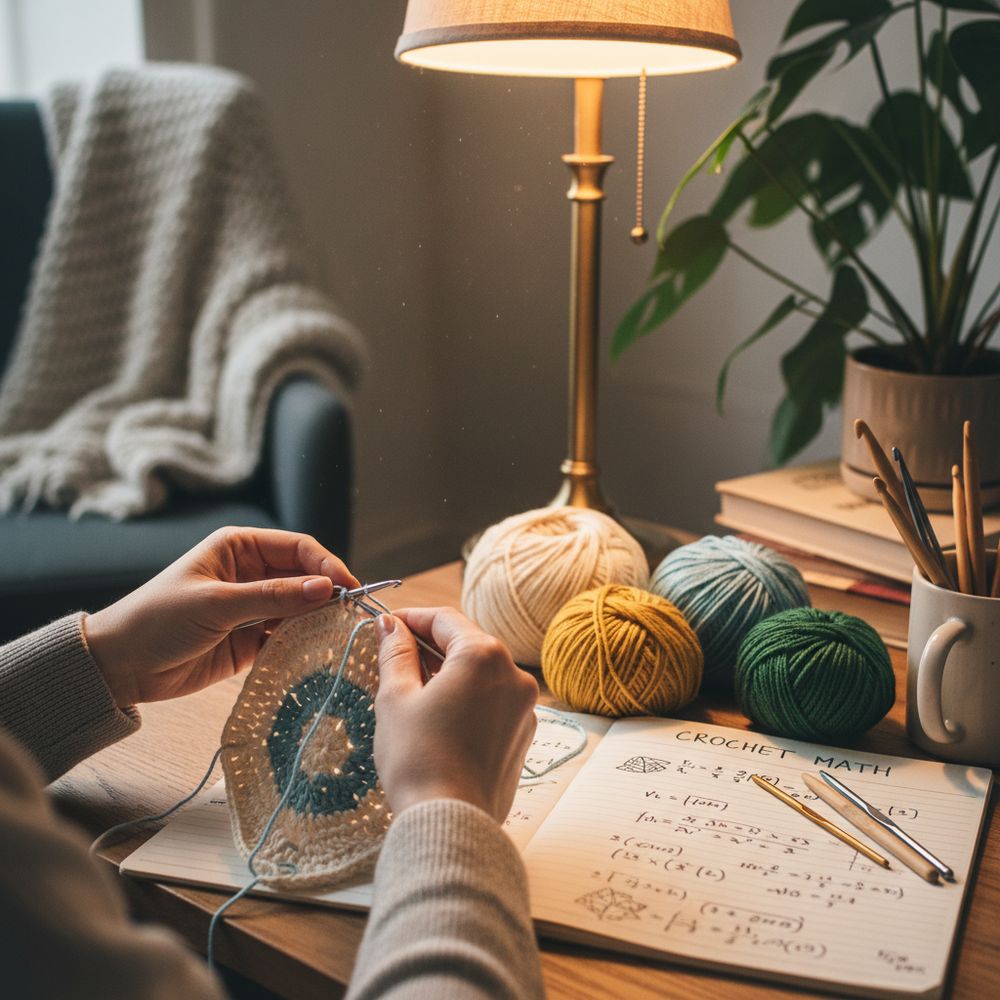
Imagine effortlessly transforming a skein of yarn into a perfectly fitting sweater, a beautifully even blanket, or an adorable, symmetrically shaped amigurumi. Picture the joy of following a pattern with unwavering confidence, knowing exactly why each stitch matters and how it contributes to the final masterpiece. No more frustration over lopsided edges, mismatched sizes, or patterns that just don't seem to add up! This magical transformation isn't just a dream; it’s the power of understanding crochet math, a simple, empowering skill that will elevate your crafting from guesswork to glorious creation, making every project a triumph.
Welcome to the world of crochet where precision meets creativity! While the idea of "math" might send shivers down some crafters' spines, fear not. Crochet math isn't about complex equations or calculus; it's about understanding the fundamental principles that govern your stitches, rows, and overall project shape. It's the secret sauce that ensures your creations look intentional, symmetrical, and exactly as you envisioned (or better!). This beginner's guide will break down these essential concepts, making them easy to grasp and even easier to apply.
Why It Matters: The Power of Precision
Why bother with crochet math? Because it’s the bedrock of successful crocheting. Here’s why mastering these basic principles is a game-changer:
- Achieve Accurate Sizing: Whether you're making a garment, a hat, or a blanket, understanding gauge and stitch counts ensures your finished project is the size it's supposed to be, fitting perfectly and looking fabulous.
- Ensure Consistent Shaping: From a perfectly flat circle to a neatly tapered decrease, math guides your increases and decreases, resulting in smooth, professional-looking shapes rather than lumpy or uneven ones.
- Flawless Pattern Following: When you understand stitch counts and repeats, you can confidently read any pattern, identify potential errors (yours or the pattern writer's!), and troubleshoot issues before they become major problems.
- Unlock Creative Freedom: With a solid grasp of how stitches build and shape, you gain the confidence to modify existing patterns, create your own designs, and truly express your unique vision.
- Boost Confidence & Reduce Frustration: No more guessing! Knowing the "why" behind the "how" reduces errors, prevents frogging (undoing your work), and makes your crocheting experience much more enjoyable and rewarding.
What You Need to Know: Key Concepts
Before we dive into the "how," let's familiarize ourselves with the core components of crochet math:
- Stitch Counts: The number of stitches in a given row or round. This is the most fundamental concept and the starting point for all crochet math.
- Row/Round Counts: Keeping track of how many vertical lines (rows) or concentric circles (rounds) you've completed.
- Gauge: The density of your crochet fabric, typically measured as a certain number of stitches and rows per inch (or centimeter). It's determined by your hook size, yarn weight, and personal tension. Gauge is CRITICAL for sizing.
- Increases (inc): Adding stitches to your work to expand its size, create curves, or flare out a shape.
- Decreases (dec): Removing stitches from your work to reduce its size, taper a shape, or create corners.
- Pattern Repeats: Instructions that are repeated multiple times across a row or round, often indicated by asterisks (*) or parentheses ( ). Understanding how to calculate the total stitches for a repeat is key.
- Basic Geometry: Understanding how to build flat shapes like circles, squares, and triangles using consistent increases and decreases.
The Math in Action: Building Blocks of Crochet
Let's put these concepts into practice with some real-world crochet examples.
Understanding Stitch Counts
Counting stitches is like counting individual links in a chain. For most stitches, you'll look for the "V" shape at the top of the stitch. Each "V" represents one stitch.
Example: Single Crochet (sc) Row
- Chain 10 (ch 10). This is your foundation chain.
- Single crochet (sc) in the 2nd chain from the hook and in each chain across.
If you count carefully, you will find you have 9 single crochet stitches. Why? Because the first chain you skipped counts as the height needed for the first sc, essentially "using up" one chain. So, 10 (total chains) - 1 (skipped chain) = 9 stitches. This simple subtraction is your first step in crochet math!
Mastering Gauge Swatches
A gauge swatch is a small sample of your intended stitch pattern, made with your chosen yarn and hook, used to measure your personal tension.
How to Make and Measure a Swatch:
- Work a Foundation Chain: Chain enough stitches to make a swatch at least 6 inches (15 cm) wide. For example, if the pattern gauge is 4 sc = 1 inch, you'd chain about 25-30 stitches.
- Crochet Several Rows/Rounds: Work in the stitch pattern specified by your pattern for about 4-6 inches (10-15 cm) in height. For single crochet, this might be 20 sc stitches for 15 rows.
- Measure: Lay your swatch flat on a hard surface. Place a ruler or measuring tape over the center of your swatch. Count how many stitches fit within a 4-inch (10 cm) span and how many rows fit within a 4-inch (10 cm) span.
- Compare & Adjust: If your swatch has more stitches/rows than the pattern, your tension is too tight; try a larger hook. If it has fewer, your tension is too loose; try a smaller hook. Repeat until your gauge matches the pattern's. This might seem tedious, but it saves hours of frogging later!
Shaping with Increases and Decreases
Increases and decreases are how you manipulate your stitch count to create shape.
-
Increases (inc)
An increase means working two (or more) stitches into a single stitch from the previous row/round. The most common increase is working 2 single crochet (sc) into the same stitch (often written as "inc" or "2 sc in next st").
Example: Single Crochet Increase
If you have 10 sc stitches and you work "sc in next 4 sts, inc, sc in next 5 sts", you will now have 11 stitches. You've added one stitch by working two into one spot. -
Decreases (dec)
A decrease means working two (or more) stitches together so they become one stitch. The most common is the single crochet 2 together (sc2tog).
Example: Single Crochet Decrease (sc2tog)
1. Insert hook into next stitch, yarn over, pull up a loop (2 loops on hook).
2. Insert hook into next stitch, yarn over, pull up a loop (3 loops on hook).
3. Yarn over, pull through all 3 loops on hook (1 stitch created from 2).If you have 10 sc stitches and you work "sc in next 4 sts, sc2tog, sc in next 4 sts", you will now have 9 stitches. You've removed one stitch.
The Magic of Repeats
Pattern repeats streamline instructions. They tell you to do a sequence of stitches a certain number of times. They are often enclosed in asterisks (*...*) or parentheses ((...)).
Example: Repeating Stitch Pattern
Row 1: Ch 1 (does not count as st), sc in first st, *ch 1, skip next st, sc in next st* repeat across to last st, sc in last st. (Assume you started with 20 stitches)
Let's break the math: The repeat *ch 1, skip next st, sc in next st* uses 3 stitches from the previous row, but only creates 2 "active" stitches (a chain space and a sc). If you have 20 stitches, and the repeat uses 2 stitches from the previous row (one skipped, one worked into), you'll have 20 stitches at the end of the row. The "ch 1" creates an open space, effectively replacing the skipped stitch.
Crocheting Flat Shapes: Circles & Squares
These shapes rely on consistent increases.
-
Circles
Flat circles are typically made by starting with a small number of stitches in a magic ring (or chain circle) and then increasing the same number of stitches evenly in each subsequent round.
Example: Single Crochet Circle
- Round 1: Magic ring, 6 sc into ring. Join with sl st to first sc. (6 stitches)
- Round 2: Ch 1, 2 sc in each stitch around. Join with sl st. (12 stitches) (You increased 6 stitches)
- Round 3: Ch 1, *sc in next st, 2 sc in next st (inc)* repeat 6 times around. Join with sl st. (18 stitches) (You increased 6 stitches)
- Round 4: Ch 1, *sc in next 2 sts, 2 sc in next st (inc)* repeat 6 times around. Join with sl st. (24 stitches) (You increased 6 stitches)
Notice the pattern: for a flat sc circle, you add 6 stitches in each round, distributing them evenly. This principle can be adapted for half double crochet (hdc) (often +8 per round) or double crochet (dc) (often +12 per round).
-
Squares
Squares are formed by creating "corners" with multiple stitches and chain spaces in specific points.
Example: Double Crochet (dc) Square (Granny Square style)
- Round 1: Ch 4, sl st to join to form a ring. Ch 3 (counts as 1 dc), 2 dc into ring, ch 2 (corner), *3 dc into ring, ch 2 (corner)* 3 times. Join with sl st to top of beg ch 3. (12 dc, 4 ch-2 spaces)
- Round 2: Sl st into first ch-2 space. Ch 3, (2 dc, ch 2, 3 dc) into same ch-2 space (first corner made). *Skip next 3 dc. (3 dc, ch 2, 3 dc) into next ch-2 space (corner made)* 3 times. Join with sl st to top of beg ch 3. (24 dc, 4 ch-2 spaces)
The math here is about maintaining 4 corners where you consistently add stitches (often 2-3 dc + ch 2 + 2-3 dc) to expand the square outwards.
Common Mistakes to Avoid
- Skipping the Gauge Swatch: The number one culprit for projects that don't fit! Always swatch, especially for wearables.
- Not Counting Regularly: It's easy to lose or gain a stitch without realizing it. Count at the end of every row/round, or at least every few rows.
- Incorrectly Counting Turning Chains: Some patterns count turning chains as stitches, others don't. Read carefully! If a pattern says "Ch 3 counts as 1 dc," then you skip the first stitch and work into the second. If it says "Ch 3 does not count as 1 dc," then you work into the very first stitch.
- Misinterpreting Pattern Repeats: Make sure you understand exactly what's inside the asterisks or parentheses and how many times to repeat it.
- Not Knowing Stitch Anatomy: Understanding where to insert your hook (into the "V," into a chain space, around a post) is crucial for accurate stitch placement and counting.
Pro Tips for Mastering Crochet Math
- Use Stitch Markers: Place a stitch marker in the first and last stitch of each row, or at the beginning of each repeat section. This helps immensely with counting and staying on track.
- Count, Count, Count: Make it a habit! A quick count at the end of each row takes seconds but saves hours of frustration.
- Take Notes: If you're modifying a pattern or designing your own, jot down your stitch counts per row/round.
- Work in Good Light: It's much easier to see individual stitches and count accurately when you have proper lighting.
- Don't Be Afraid to Frog: If your stitch count is off by more than one or two, don't try to "fix" it by adding/skipping stitches randomly. It's usually better to frog back to where the error occurred and redo it correctly.
- Understand Stitch Heights: A chain 1 turning chain for sc, a chain 2 for hdc, and a chain 3 for dc ensure your edges are straight and your project grows evenly.
FAQ: Your Crochet Math Questions Answered
Do I really need to do a gauge swatch for every project?
For most projects where size matters (garments, hats, blankets that need to be a specific size), yes, absolutely! Your gauge can vary significantly even with the same yarn and hook due to your personal tension. For items where size isn't critical (e.g., dishcloths, some amigurumi), you can skip it, but it's always good practice to check if you want your item to closely resemble the pattern photo.
What if my stitch count is off by one or two stitches?
If you're only off by one stitch, you might be able to subtly increase or decrease it in the next row without it being too noticeable, especially if you catch it quickly. However, if you're consistently off or the error is larger, it's always best to frog back to the last correct row and fix it. Early detection is key!
Is crochet math the same for all stitch patterns?
The underlying principles of crochet math (counting, increasing, decreasing, gauge) are the same across all stitch patterns. What changes is the specific number of stitches, repeats, and gauge requirements for each unique pattern. A lace pattern will have different stitch counts and repeat structures than a solid fabric, but you'll still apply the same mathematical thinking to follow it.
Congratulations, you've just taken a huge step towards becoming a more confident and skilled crocheter! Crochet math isn't a barrier; it's a powerful tool that unlocks endless possibilities. By understanding stitch counts, gauge, and how to shape your fabric, you're gaining the ability to create truly stunning, professional-quality pieces. Practice these concepts regularly, and soon, you'll be reading patterns like a pro, designing your own creations, and enjoying the mindful, mathematical magic of crochet!